Letting Go of the Cartridges: The Real Reason Adult Gamers Are Clearing Out Their Collections
Photo: Meanwell Packaging, CC BY 2.0, via Wikimedia Commons
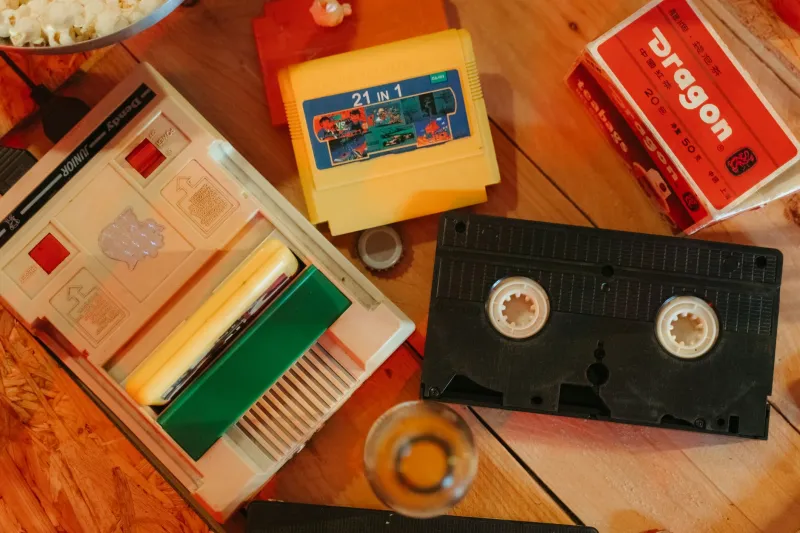
For years, the narrative around retro gaming has been one of accumulation. More cartridges. More consoles. More shelf space dedicated to the pixelated artifacts of a childhood well spent. But lately, something is shifting. Quietly, without much fanfare, a growing number of millennial and Gen X gamers are doing the opposite — they're letting it all go.
Facebook Marketplace listings. eBay auctions. Cardboard boxes dropped off at Goodwill with a dozen NES games tucked inside. The great retro game giveaway is happening in real time, and the reasons behind it are more complicated — and more human — than you might expect.
The Collection That Grew While Life Didn't Wait
Ask anyone who spent the late '90s and early 2000s haunting garage sales and thrift stores for gaming gold, and they'll tell you the same thing: collecting was never really about the games. It was about reclaiming something. A feeling. The Saturday morning energy of sitting cross-legged in front of a CRT with a controller in your hands and nowhere else to be.
But somewhere between the second kid and the third job change, the collection stopped feeling like a connection to that feeling and started feeling like furniture.
"I had over 400 SNES and Genesis games," says Marcus, a 41-year-old IT manager from Columbus, Ohio. "At some point I walked into the room where I kept everything and realized I hadn't touched any of it in almost two years. It wasn't a shrine anymore. It was just... stuff taking up space in a house where space is suddenly really valuable."
Marcus sold the bulk of his collection last spring through a combination of local Facebook groups and a regional retro gaming convention. He kept about 30 games — the ones that actually meant something specific to him — and donated the rest to a youth center in his neighborhood.
He doesn't regret it.
Life Changes Are the Biggest Trigger
Talk to resellers and donation center coordinators around the country, and you start to hear the same life events come up again and again. Divorce. A parent passing away and suddenly needing to clear out a childhood home. A new baby arriving and a spare room transforming into a nursery overnight. A cross-country move that forces a ruthless reckoning with how many boxes you're actually willing to pay to ship.
"We see it in waves," says Diane, who runs intake at a nonprofit thrift store in the Denver metro area. "There's always a spike after the holidays, but we've noticed more retro gaming stuff coming in over the last couple of years specifically. Controllers, games, even full consoles. A lot of it is clearly someone's collection, not just a random find from a closet."
For resellers, the influx has been a mixed blessing. More supply keeps prices accessible for new collectors entering the hobby, but it also signals something culturally significant. The generation that grew up treating these objects as sacred is now old enough to start making the hard calls about what actually earns a place in a smaller, busier life.
It's Not Apathy — It's Evolution
Here's what's easy to get wrong about this trend: assuming it means people have stopped caring about retro gaming. That couldn't be further from the truth.
What's actually happening is more nuanced. The relationship is changing. The physical object — the cartridge, the box, the manual — is losing some of its totemic power for people who have spent two decades proving something to themselves through collecting. The nostalgia is still there. The love for the games is absolutely still there. But the expression of that love is shifting.
Streaming playthroughs on YouTube. Picking up a well-curated mini console. Downloading a handful of favorites on a Switch and playing them on a lunch break. These are the ways a lot of former hardcore collectors are staying connected to their gaming roots without needing a dedicated room and a climate-controlled storage solution.
"I think a lot of us spent years chasing completeness," says Jenna, a 38-year-old graphic designer in Portland who recently sold off the majority of her Game Boy collection. "Like if I had every game in a series, or every regional variant of a console, that meant something. And now I'm at a point in my life where I'd rather have the five games I actually love than two hundred games I'm just maintaining."
That shift from quantity to quality — from collection as achievement to collection as curation — might actually be the healthiest evolution the hobby has seen.
What Happens to the Games That Get Let Go
The downstream effect of all this liquidation is worth paying attention to. Games that end up at thrift stores are often discovered by a younger generation encountering retro hardware for the first time. A teenager who finds a copy of Earthbound at a Salvation Army isn't just getting a game — they're getting a portal.
Resellers are playing a curatorial role too, even if it's an imperfect one. By pricing and presenting these games with context, they're helping transmit the culture forward. The kid who buys a cleaned-up SNES bundle from a local game shop is getting more than hardware — they're getting inducted.
And for the collectors who are letting go? Many describe the experience as genuinely freeing. Not sad. Not a defeat. Just a natural exhale after years of holding on.
"I kept my original copy of Chrono Trigger," Marcus says. "The one I actually played as a kid. Everything else was replaceable. That one isn't."
The Part You Keep Is the Part That Matters
Maybe that's the real lesson inside this quiet cultural shift. Retro gaming was never really about ownership. It was about memory, identity, and the specific joy of a medium that shaped an entire generation's inner life. Those things don't live in a cartridge. They live in you.
The collection was always just a way of keeping the door open. And for a lot of people right now, it turns out you don't need two hundred cartridges to walk back through it. You just need the right one.
So if you've been eyeing that stack of games in the corner and wondering whether it's time — maybe it is. Keep what's irreplaceable. Let the rest find a new kid to haunt.
That's not losing the past. That's passing it on.