What Your Arcade Cabinet Picks Say About the Person You Were Trying to Become
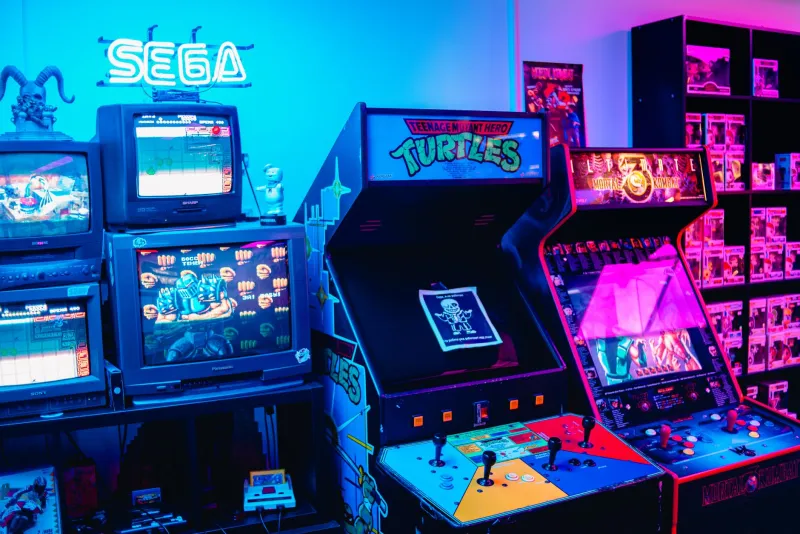
There's a moment that happens to almost everyone who finally gets an arcade cabinet into their house. You plug it in, the screen flickers to life, the attract mode kicks on — and something shifts. It's not just nostalgia. It's more specific than that. It's almost archaeological, like you've just uncovered a version of yourself you'd half-forgotten existed.
That feeling is worth paying attention to. Because the game you chose — out of hundreds of options, across decades of arcade history — wasn't random. It says something.
The Cabinet You Chose Isn't Really About the Game
Ask someone why they tracked down a Ms. Pac-Man cabinet versus a Street Fighter II versus a Galaga, and they'll usually start with the practical stuff. Availability. Price. Condition. But push a little further and the real answer surfaces: they played that game at a specific place, during a specific stretch of their life, and something about that period got permanently embedded in the memory.
Psychologists call this the reminiscence bump — the tendency for people to have stronger, more vivid memories of experiences that happened between the ages of 10 and 25. It's the window when identity is forming fastest, when everything feels like it matters more, when a song or a movie or yes, a video game, can get locked into your brain with a kind of permanence that nothing in adult life quite replicates.
Arcade cabinets are physical anchors for those memories. When you restore one, you're not just fixing up a machine. You're reconstructing a moment in time that felt formative — even if you couldn't have articulated why back then.
The Generational Fault Lines Are Real
Spend any time in retro gaming communities and you start to notice the patterns. Gen X collectors skew heavily toward late-'70s and early-'80s titles — Asteroids, Centipede, Donkey Kong, Defender. These were the games that defined the first golden age of arcades, when the machines themselves were a novelty, when walking into a 7-Eleven and seeing a glowing cabinet felt genuinely futuristic.
For that generation, the arcade wasn't just entertainment. It was access to something that felt adult and urban and slightly dangerous. You were spending your own money, making your own decisions, existing in a semi-public space without supervision. The games they gravitate toward now carry all of that with them.
Millennials tell a different story. The cabinets that hit hardest for that cohort tend to cluster around the late-'80s through mid-'90s — Mortal Kombat, NBA Jam, X-Men, The Simpsons, Teenage Mutant Ninja Turtles. These were games built around licensed properties and multiplayer chaos, designed for a generation that grew up with Saturday morning cartoons and had strong opinions about which characters were worth playing.
For millennials, the arcade was often a social proving ground. The cabinet you were good at said something about you. It was a place to compete, to impress, to belong. The nostalgia that pulls them back to those machines is tangled up with questions of identity and belonging in ways that go deeper than the gameplay itself.
What the Restoration Process Actually Reveals
There's a specific kind of person who doesn't just buy a working cabinet — they find a broken one and fix it. And that choice is its own kind of psychological tell.
Restoring an arcade cabinet is slow, tedious, sometimes maddening work. You're hunting down replacement parts, learning about monitor cap kits, figuring out why the sound board is buzzing, touching up artwork that's been water-damaged or sun-faded for thirty years. It's not the easy path to owning a piece of gaming history. It's the hard one.
The people who choose it tend to describe the process in terms that sound less like a hobby and more like a relationship. They talk about the machine the way you'd talk about a car you grew up riding in, or a house that's been in the family. There's an obligation in it. A sense that the thing deserves to be saved.
That impulse — to rescue and restore rather than simply acquire — often maps onto something the collector experienced personally. A childhood that felt chaotic or unstable. A sense that certain things slipped away before they could be appreciated. The cabinet becomes a stand-in for something that couldn't actually be recovered, something that got lost in the ordinary entropy of growing up.
The Games That Define Eras We Didn't Know Were Ending
One of the stranger patterns in arcade collecting is how often people gravitate toward games from the last year or two they actually spent time in arcades — the period just before home consoles got good enough to pull them away for good.
For a lot of Gen X collectors, that inflection point hit somewhere around 1990 to 1992, when the Super Nintendo arrived and the arcade trip suddenly felt less necessary. For millennials, it came a few years later, somewhere in the mid-'90s, when Mortal Kombat showed up on home consoles and the living room finally caught up.
The games from those transition periods carry a particular weight. They represent the end of something, even if you didn't recognize it at the time. Collecting them now is a way of honoring a chapter that closed without ceremony — no goodbye, no acknowledgment, just a gradual drift toward different habits and different places.
The Cabinet in the Basement Is Doing More Than You Think
None of this is to say that owning an arcade cabinet is some kind of covert therapy session. Plenty of people buy them because they look cool, or because they genuinely love the game, or because they wanted something interesting to put in their game room that isn't just another piece of flat furniture.
But the machines accumulate meaning whether you invite it or not. They become conversation starters that turn into real conversations — about where you grew up, what the local arcade was like, who you used to go with, what it felt like to be that age in that place at that particular moment in American culture.
That's not nothing. In a world where most entertainment is delivered through screens that look identical and algorithms that optimize for engagement, there's something genuinely different about a 300-pound wooden cabinet that boots up the same way it did in 1987. It doesn't adapt to you. It just is what it is, exactly as it was.
And somehow, that's exactly the point.
The cabinet in your basement isn't showing you the past. It's showing you which parts of the past you decided were worth keeping — and that, it turns out, is one of the more honest things you can learn about yourself.