How GameStop Gave Away a Fortune One Trade-In at a Time
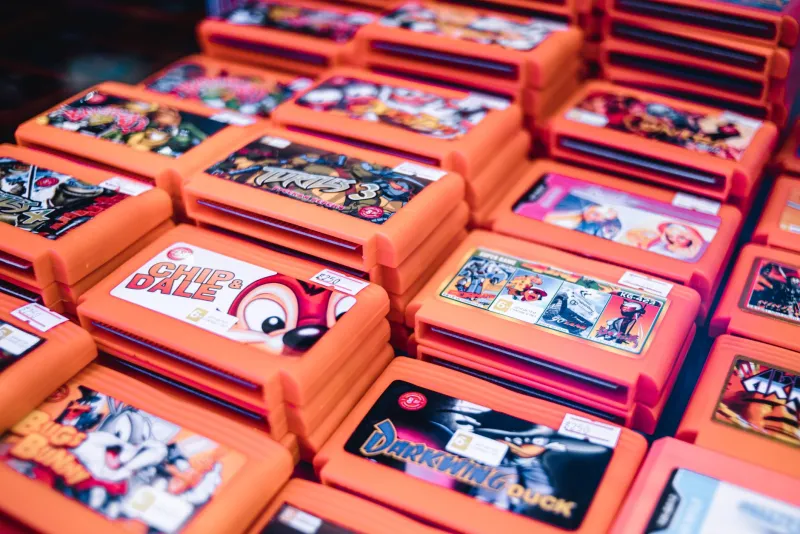
Somewhere around 2015, a guy in Columbus, Ohio walked into a GameStop with a shoebox full of SNES cartridges. He'd moved back in with his parents after a rough patch, needed gas money, and figured the games were just taking up space anyway. The clerk behind the counter offered him store credit — a few dollars per cart, maybe twelve bucks for the lot. He took it.
That shoebox probably contained close to $400 worth of games by today's market. He got enough credit for a used copy of Destiny.
This isn't a story about one unlucky guy. It's a story about a decade of institutional misjudgment — and what it reveals about how badly the mainstream retail world underestimated retro gaming's staying power.
The Retro Section Nobody Took Seriously
If you walked into a GameStop between 2010 and 2016, the retro section — when it existed at all — was usually a wire rack near the back, crammed between the used Xbox 360 games and a display of phone cases nobody wanted. NES, SNES, Genesis, N64: the whole golden era of home gaming, stacked in a bin like it was a garage sale.
Pricing reflected that attitude. Original copies of EarthBound for SNES were routinely tagged at $15 to $25 in stores, when they were already trading hands online for three to four times that. Chrono Trigger sat in the $10 range. Castlevania: Symphony of the Night on PS1 — a game that now commands serious money in complete condition — was practically given away.
Store managers at the time weren't setting those prices out of malice. They were following corporate valuation systems that hadn't been updated to reflect what was actually happening in the collector market. GameStop's trade-in algorithm was built around demand signals from its own sales data, and if a game wasn't moving fast off the shelf in their stores, it got priced low to clear inventory.
The problem: the people buying those games at those prices weren't reselling them back to GameStop. They were taking them to eBay, to collector forums, to the growing network of retro-focused shops that understood what they were actually worth.
The Data Gap That Cost Sellers Everything
Talk to anyone who collected seriously during that window and you'll hear the same story with different details. A sealed copy of Little Samson for NES picked up for a song. A complete Panzer Dragoon Saga for Saturn sitting in a display case at a fraction of its actual value. A stack of Game Boy Color games priced like they were going to the recycling bin.
Pricing data from platforms like Price Charting — which tracks retro game values the way Kelley Blue Book tracks used cars — shows a consistent pattern. Between 2010 and 2016, retail trade-in values for classic titles lagged significantly behind secondary market prices. For some titles, the gap was 200 to 400 percent.
The disconnect happened because GameStop was essentially using rearview-mirror logic. Their systems looked at recent sales history within their own network. But the retro game market was exploding on eBay, at conventions, and in independent shops — none of which fed back into GameStop's pricing model.
By the time corporate caught up, a lot of the inventory had already walked out the door.
What the Collectors Knew That the Algorithm Didn't
The collectors who thrived during this era weren't operating on some secret knowledge. They just understood something GameStop's systems couldn't process: nostalgia compounds.
The kids who grew up playing SNES in the early '90s were hitting their late twenties and thirties by 2010. They had disposable income for the first time. They were starting to feel the pull of those childhood memories — the specific weight of a cartridge, the sound of a startup screen, the feel of a controller that wasn't trying to be ergonomic. And they were willing to pay for it.
Retro gaming wasn't a niche hobby quietly fading out. It was building toward a cultural moment. YouTube channels dedicated to classic game history were racking up millions of views. Speedrunning communities were turning old games into competitive sports. Independent developers were making careers out of games that looked and felt like 1993.
GameStop's model, built around chasing the new release cycle, simply wasn't designed to see any of that coming.
The Shift That Finally Happened — Too Late for Most
By around 2017 and 2018, something changed. GameStop started pulling retro inventory from stores and consolidating it into select locations. Prices crept up. The wire rack in the back got replaced, in some stores, by a locked glass case. The casual $5 SNES bin became a distant memory.
But the damage — depending on how you look at it — was already done. The underpriced inventory had dispersed into the collector market, where it was being resold at multiples. The window of retail arbitrage that sharp-eyed collectors had exploited for years was closing.
For the people who'd traded in their collections during the low-value years, there was no recovering those losses. They'd taken store credit for games that would eventually be worth hundreds, sometimes more, and spent it on titles that are now in the $3 used bin.
It's easy to assign blame to GameStop for the undervaluation, and that blame isn't entirely unfair. But the honest answer is that almost nobody — retailers, casual gamers, even most collectors — fully anticipated how aggressively the retro market would appreciate. The people who got it right were outliers.
What the Trade-In Trap Actually Teaches Us
There's a version of this story that's just about money — about missed financial opportunities and corporate pricing failures. But that's not really what stings for most people who lived through it.
What stings is the cultural dismissal. The implicit message that the games you grew up with were worth a few bucks of store credit, that the hours you spent with them were just data points in a depreciation curve. GameStop's retro section in its bargain-bin era wasn't just a bad deal. It was a statement about how the mainstream viewed classic gaming: as a dead format, not a living culture.
The collectors who were paying attention knew better. The independent shops that were quietly buying those trade-ins and flipping them knew better. And eventually, the market caught up with what those people already understood.
Your old games were never just old games. They were time capsules, cultural artifacts, and — it turned out — appreciating assets. GameStop figured that out late. The question is whether you did too.
If you've still got cartridges sitting in a bin somewhere, maybe don't rush to trade them in.